

Before Greenwich Mean Time, sailors could find latitude by measuring the Sun’s height but longitude was chaos. Without a reference clock, “east” and “west” were guesses. They followed the Sun for latitude, not coordinates. The result: continents discovered, but their positions off by hundreds of miles.
In 1675, King Charles II of England founded the Royal Observatory at Greenwich to solve this “longitude problem”. But knowing the time at Greenwich meant nothing if a ship couldn’t carry it.
That changed when John Harrison built the first marine chronometer in the 1700s and when the Nautical Almanac, published by the Royal Observatory, gave sailors the celestial data to use it. A ship could finally bring Greenwich time to sea and know its longitude precisely. Navigation turned from exploration to measurement. Science replaced instinct.
Three centuries later, the same principle runs the Internet. Your computer keeps time not with the Sun, but with a quartz crystal, its own digital chronometer. At the hardware level, a small Real-Time Clock (RTC) keeps ticking even when the machine is off, powered by that quartz oscillator. When the system boots, it reads the RTC as a starting point, then measures time internally using CPU timers. But quartz, like a ship’s chronometer, is never perfect, it drifts with temperature, voltage, and age.
To stay aligned with reality, the operating system periodically synchronizes its clock with UTC (Coordinated Universal Time) through the Network Time Protocol (NTP).
UTC, built on atomic clocks, is the modern successor of Greenwich Mean Time, the same meridian that once guided sailors across the oceans.
The process is digital, but the idea is centuries old. Where ships once watched the Deal time ball, synchronized to Greenwich, drop at 1 p.m. before setting sail, computers now “watch” atomic time signals pulse across the Internet. Where 19th-century observatories sent telegraph pulses down railway cables to synchronize clocks across Europe, NTP packets now race through fiber-optic lines to keep servers in step.
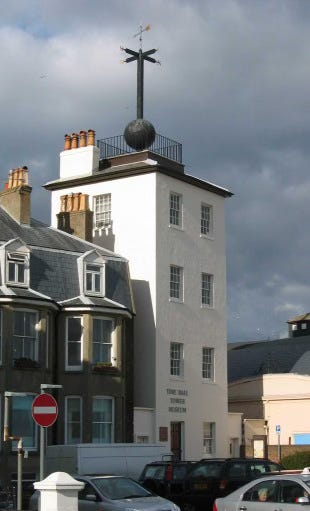
Deal Time Ball Tower in 2005
Disconnected from the network, a computer slowly loses true time, just as a ship once drifted off longitude when sailing too long without checking the Greenwich signal.
Different centuries. Same mission: Keep time honest.
Links: